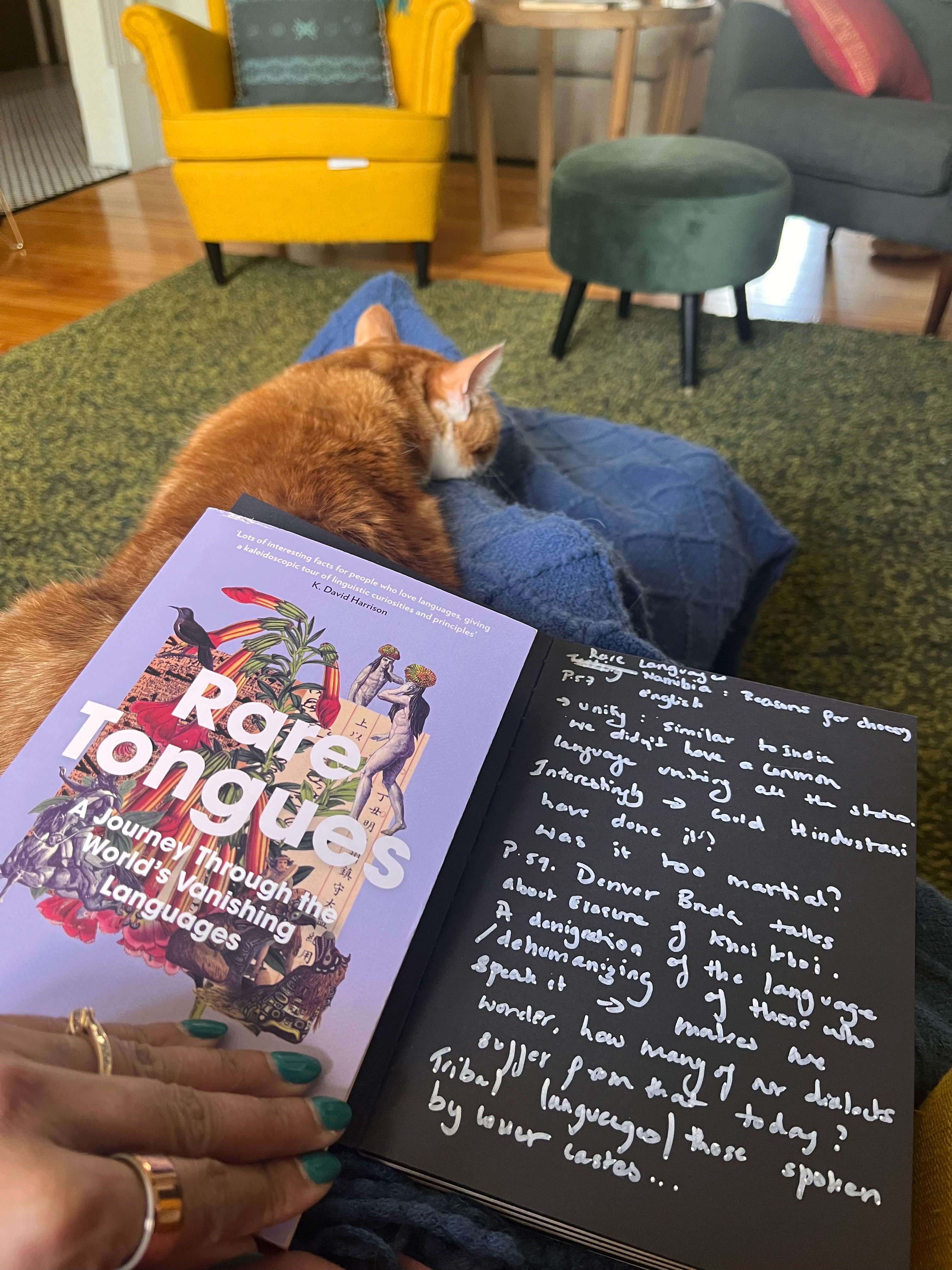
A few weeks ago, I pickup up this book at a bookshop in Istanbul. Language and identity fascinate me, partly because I personally struggle with the discord between my linguistic identity and my language of practice.
The book held a promise of exploring lesser known languages and perhaps delving into what we lose as a community, as a civilization, when we lose a language. I grew up in a home where language was a well-debated and explored topic. My parents are both Sylhetti, and speak the dialect with family and at home. However, for me, the mother language I grew up with was Bengali — the written/purist form of Bengali. Growing up in Delhi, this already felt unique. Delhi has an odd enforced homogeneity. As the vastly cosmopolitan capital of India, one would think it would be the opposite — but there is something about bureaucratic “wannabe” English snobbery that erases the sense of self in this city. Looking back there seemed to be only two acceptable identities in Delhi if you wanted to assimilate — the posh almost Brit, or some flavour of a hindi-speaking Punjabi. The rest of the identities, while prevalent, were relegated to a novelty — the Durga puja theatrics, the Urdu poetry sessions, the Karnataka house or Andhra Bhavan, and the emporiums on Baba Khadak Singh Marg.
My parents’ childhood in Assam was fraught with linguistic conflict, particularly for my mom, who faced active discrimination all through her university days for the crime of being Bengali in a political landscape that was increasingly charged with the othering of Bengalis. The historical politics leading up to those moments are perhaps a chapter for another day. Her linguistic identity was forged consciously — Bengali was her birthright, but without the bigotry of it all — she learned Assamese, and chose to speak it.
For her, teaching me the Bengali alphabet and speaking the language at home was not a choice — how could one deprive their child of the richness that the language, its music and poetry could bring? For my mother, Bengali is a philosophy. You live through the language, you think through the language — you love in the language, and you grieve in the language. For me, however, navigating my Bengali identity in a city that fetishisizes identity and language into bite-sized consumables was harder. Finding myself often having to defend Tagore (crazy, because who am I to even defend his legacy), or Ray’s genius as a director, or the Bengali argumentative consciousness — I was confronted by what it means to be Bengali over and over again. I was also, sadly, exposed to the brutal reality, that in Delhi, the Hindi-speaking middle class, with its somewhat underexposure to global intellectual thinking and their dissonance from their own linguistic roots, did not, in fact, want to support or participate in the survival of other Indian languages and dialects. The ground was always ripe for bigotry, and I likely would have morphed into a Bengali supremacist, had it not been for the outward-looking thought I was raised with at home.
It’s been over 15 years since I’ve left Delhi, and funnily enough, I find myself living now in Quebec, smack-dab in the midst of yet another linguistic conflict. This conflict is pervasive, has been created and nurtured with historical colonization, and a subsequent retaliatory aggression that has almost made everyone forget why we love languages.
In all of this, I found Gibb’s book, hiding away in a non-fiction corner of the bookstore in Istanbul, a country with its own history of linguistic and ethnic diversity.
The book is a great starter kit for those who want to learn about the world of languages. It touches upon eco-linguistic disciplines, a variety of languages that exist in the world, and also tries to draw attention to the relationship between languages and conflicts.
There were two aspects where the book could have gone deeper, in my opinion, and where I had expected perhaps a more nuanced opinion.
The book talks a lot about the impact of colonialism on diminishing the practice of a language but draws short on going in depth. To me, it felt like the familiar white-person narrative on colonialism — that Gibb was somehow not comfortable acknowledging who the colonizers were and what they did, or her own shared histories with the colonizers. It leaves much of the narrative discombobulated, because she fails to call out the perpetrators of linguistic genocide actively, relying on implied blame on conquistadors, and colonizers. She also fails to speak of colonizers outside of the Western European world. In India, for instance, there is a majoritarian language dominance that is threatening to supersede all else. The propaganda machine for their language is not the traditional colonizing by a Western power, or even just the government. It’s pop culture, it’s the pervasiveness of a particular language finding the most funding, finding the support to obliterate all other languages. This is true in China, in Japan and many African, Asian and Latin American nations. she touches upon these briefly, but doesn’t truly explore the means with which this subjugation continues, even of languages that are not fully endangered, yet.
The second area where Gibb truly falls short is drawing a direct line between the survival of languages and late-stage capitalism. She mentions with reference to Scots and Scottish Gaelic, that the usage of these languages is diminishing because people find no perceived value in learning and practicing those languages. Oddly, that is what we hear from parents in Silchar, Kolkata and Delhi — many of my Bengali peers in Delhi speak incorrect grammar, can’t read or write the language. Many parents in Calcutta and Silchar, which are majority Bangla speaking, send their children to English medium schools where speaking the vernacular is punished, but then again, the quality of English isn’t muhc better,
This perceived “value” of a language and the desire to only speak or learn it if there is a monetary outcome associated with it is one of the main reasons why languages are dying. Today, we may have 1 language dying every 14 days, but many of the languages spoken by large swathes of populations are equally at risk of dying out over time if not supported organically by daily practice. There are fewer people studying linguistics today (see MLA report here). Learning ones own mother language is often considered to be a “hobby” or something extra-curricular, when in fact, not learning the native tongue does in fact severe the child from original thinking and philosophies. A large part of this decline stems from the late-capitalist need to unify and homogenize a global workforce to execute and think alike, to not have the ability to be different.
Gibb intentionally sidesteps this issue, despite having plenty of opportunities to address it. She also doesn’t take it a lever deeper to expound on what she thinks we as citizens of a vast humanity should be doing to improve the plight of diminishing voices. Her book reads a little bit like a rare languages 101 reader, but lacks the depth when it comes to the root causes and the ongoing slaughter of languages that Big Tech, Governments, and Capitalism continues to perpetuate.

